
Check out our course catalogue below.
To book, use the Course Bookings shop.
Take a look at some of our past courses.
Multiple Weeks
Arty Books
Tuesday 22nd September - Tuesday 20th October
10:00 am
until
1:00 pm
Clevedon Community Centre
Tutor:
Jane Saker & Carol Wood
Make exciting art with popular tutor, Jane, then reconfigure your work to create beautiful artist books with another popular tutor Carol. The two work together to help you develop a new project.
Over the course of five weeks you will be making lots of art using different media and then transforming flat 2-D sheets into paper that moves and twists into unexpected 'artists' book forms.'
The course is suitable for all who want to have a bit of fun and experiment.
We plan to make a flexagon, Jacob's ladder book, one sheet folded books, flower folds, pop-ups.
Paper, card, and paints will be provided but it would be useful if you brought pencil, scissors or craft knife, ruler, glue, cutting board, a bone folder (if you have one but some will be available). An apron to protect your clothes.
Paper is very expensive so we will be charging an extra £10 to cover the cost of materials.
Tuesday 22nd September
Tuesday 29th September
Tuesday 6th October
Tuesday 13th October
Tuesday 20th October

Multiple Weeks
Thrones, Crowns and Diamonds
Wednesday 23rd September - Wednesday 4th November
10:30 am
until
12:30 pm
Clevedon Community Centre
Tutor:
Jo Edwards
Trace Indian history from the Mughal Empire through its fragmentation and the rise of the East India Company, leading to the 1857 rebellion and the British Raj.
This six week course will explore the dramatic arc of Indian history from the heights of the Mughal Empire to the symbolic politics of imperial victory in Victorian Britain. Beginning with the splendour of Akbar, Jahangir, and Shah Jahan, it traces the empire’s fragmentation, through warfare, succession crises and the rise of powerful regional states.
We will discover how the East India Company transformed from a trading venture into a territorial power, culminating in the 1857 rebellion and the establishment of the British Raj. The course concludes with the story of Maharaja Duleep Singh, the Koh‑i‑Noor, and the enduring legacies of empire and cultural memory. Trace Indian history from the Mughal Empire through its fragmentation and the rise of the East India Company, leading to the 1857 rebellion and the British Raj.
Wednesday 23rd September
Wednesday 30th September
Wednesday 7th October
Wednesday 14th October
Wednesday 21st October
Wednesday 4th November

Multiple Weeks
Selected Novels of George Eliot
Friday 25th September - Friday 6th October
10:30 am
until
12:30 am
Clevedon Community Centre
Tutor:
Greta Depledge
This six week course will look at Eliot's first two full length novels - Adam Bede (1859) and The Mill on the Floss (1860).
These novels give us a detailed depiction of rural communities. On publication, both were immediately recognised as significant literary works. The complex web of relationships is arguably what Eliot writes best.
Eliot was a well respected writer before her novels were published having written a number of scholarly works and edited the Westminster Review. Her first foray in to fiction was with a series of short stories (Scenes of Clerical Life) in 1857 and 1858.
Adam Bede tells the story of the complex relationships in a rural community dealing with love, loss, work, female autonomy, compassion and religion.
The Mill on the Floss deals with themes such as family, class, education, childhood and social pressures.
Friday 25th September
Friday 2nd October
Friday 9th October
Friday 16th October
Friday 23rd October
Friday 6th November

Single Day
Reading Pictures: La Belle Epoque
Saturday 26th September
10:30 am
until
4:30 pm
Clevedon Community Centre
Tutor:
Allan Phillipson
From 1870 to WWI, the French Third Republic produced some amazing art.
This course focuses on key figures such as Manet, Monet, Degas, Renoir, and Toulouse-Lautrec.
Explore their studios, follow them to the Moulin Rouge, and discover what they discussed at the Café de la Nouvelle-Athènes.
Learn how to drink absinthe—with a practical demonstration by Count Dracula.

Single Day
A Ground – Up Approach to Local Nature Restoration
Saturday 3rd October
10:30 am
until
4:30 pm
Clevedon Community Centre
Tutor:
Chris Sperring
This course supports any local residents, community groups, to take practical action for local nature recovery.
It follows a “ground-up” philosophy — starting small, using local knowledge, and building projects that deliver both wildlife benefits and greater resilience to climate change. No prior experience is required.
Objectives
Show how to design and implement a simple nature recovery plan
Explain how small-scale work contributes to climate resilience (cooling, flood control, carbon storage)
Cover habitat creation across gardens, parks, verges, and open spaces
Introduce suitable tree species and their roles in urban/semi-rural environments
Teach basic wildlife survey methods for beginners
Share real local examples to inspire and guide action

Single Day
The Fab Four and their Artistic Universe
Saturday 10th October
10:30 am
until
4:30 pm
St Mary's Church
Tutor:
Paul Chapman
A journey from Stu and John at art school to Yoko and Fluxus, featuring Voorman, Blake, Hamilton, BEV Collective and many more.
The world of Art and the music of the Beatles crossed paths and became entwined. From Liverpool School of Art to Bed Peace the fab four were closely aligned to visual imagery.
John and Paul not only created there own paintings but also engaged with many contemporary artist to create a visual history of the Beatles stellar career.
We will spend the day studying numerous artists and their relationship to the Fab Four.

Single Day
J S Bach: The Fifth Evangelist
Saturday 17th October
10:30 am
until
4:30 pm
Clevedon Community Centre
Tutor:
Ben England
Spend a fascinating day with award-winning musical educator and renowned conductor Ben England exploring the life, genius, and choral masterpieces of Johann Sebastian Bach.
This immersive study day charts Bach’s journey from his formative, "troublemaker" youth through to the "sacred architecture" of his greatest choral foundations, including the Magnificat and the Passions of St John and St Matthew.
You will uncover the secrets of his ultimate late-life triumphs, including how a royal attempt to embarrass the elderly composer backfired into the brilliant Musical Offering, and trace his final years and subsequent slide into obscurity.
Concluding with the spectacular Mendelssohn revival that restored Bach to his rightful place, this course is an essential companion for anyone who has ever marvelled at the sheer beauty of his music and wondered how one man could change the world forever.

Multiple Weeks
Gobekli Tepe: Ritual Society and the Dawn of Civilisation
Thursday 5th November - Thursday 10 December
10:30 am
until
12:30 am
Friends' Meeting House
Tutor:
Karen Zold
Journey back 11,000 years to explore the mysteries of Göbekli Tepe - the extraordinary prehistoric sanctuary that is reshaping our understanding of ritual, society, religion and the origins of civilization through archaeology, symbolism and ground-breaking modern investigation.
Thursday 5th November
Thursday 12th November
Thursday 19th November
Thursday 26th November
Thursday 3rd December
Thursday 10th December

Multiple Weeks
Two postcolonial novels of the British in India
Wednesday 11th November - Wednesday 16th December
10:30 am
until
12:30 pm
Clevedon Community Centre
Tutor:
Cath Humphris
JG Farrell’s 1973 novel, set in a fictional Indian town in1857, revisits the Indian Mutiny. Paul Scott’s 1977 novel is set in 1972, but draws on the memories of the characters to present a view of the end of Empire. Both were awarded the Booker Prize. Both are stand-alone reads, despite being part of sequences.
We’ll be thinking about what makes each of these novels distinctive, and share ideas about how and why they were prize winners. Farrell’s novel is often classified as an historical novel, is it Neo-Victorian? Can we call it post-modern? How do we classify Scott’s novel?
We’ll reflect on influences and ideas, and history. We’ll examine some critical points of view on a range of themes and theories. We’ll ask questions such as: What are the critical and ethical dimensions of postcolonialism? What part does comedy play in the shaping and telling of a tale? Is it useful to be able to label a novel?
The tutor will supply a full discussion schedule at the first session, dividing the two novels into manageable sections.
Please read to the end of chapter 7 of The Siege of Krishnapur for discussion at the first session.
Key texts:
The Siege of Krishnapur by J. G. Farrell
Staying On, by Paul Scott
Wednesday 11th November
Wednesday 18th November
Wednesday 25th November
Wednesday 2nd December
Wednesday 9th December
Wednesday 16th December

Multiple Weeks
Pilgrimage: the history and art of devotion
Friday 13th November - Friday 18th December
10:00 am
until
12:30 am
Clevedon Community Centre
Tutor:
Angie Smith
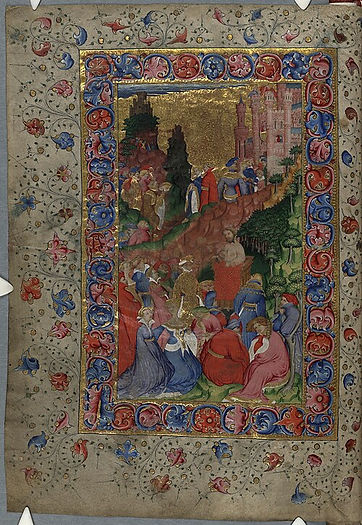
In this course we will study the phenomenon of pilgrimage in Europe in medieval times from about 1000 until the early 1500s. We will examine the social, political and religious motives that led individuals to go on pilgrimage, their destinations, the routes they took and the sites they visited on their travels.
The four most important pilgrim sites in the middle ages Jerusalem, Rome, Santiago de Compostela and Canterbury, will be studied in detail.
We will also think about some of the lesser sites that attracted pilgrims, particularly in England and Wales, including Walsingham, Glastonbury and Hailes. The course will take in elements of medieval pilgrim literature and music as well as the art and architecture associated with medieval pilgrimage.
Friday 13th November
Friday 20th November
Friday 27th November
Friday 4th December
Friday 11th December
Friday 18th December
Single Day
Music She Wrote
Saturday 14th November
10:00 am
until
4:00 pm
St Mary's Church
Tutor:
Lotti Newstead
How much classical music do you know by women? For centuries, women have composed extraordinary music, yet many of their names remain far less familiar than those of their male contemporaries.
This all-day study event explores nearly a thousand years of music history through the lives and works of women composers, from the visionary medieval world of Hildegard of Bingen to the distinctive contemporary voice of Caroline Shaw.
Across the day, we will trace changing musical styles, shifting creative worlds and evolving opportunities, encountering composers including Barbara Strozzi, Fanny Mendelssohn, Clara Schumann, Lili Boulanger and many others.
Along the way we will hear music that is intimate, dramatic, lyrical, experimental and ambitious, discovering a broader and more varied picture of classical music history.

Single Day
Circus: a Visual History
Saturday 21st November
10:00 am
until
4:00 pm
Clevedon Community Centre
Tutor:
Paul Chapman
The art of the circus from it's origins in the ancient world to the present day. Painters, sculptures, and film makers have always been fascinated by the circus and it's array of performers. They captured the range of circus life in 3D, on canvas and on film.
From the early days in ancient Greece and Rome to the 21stC artists have always been fascinated by the circus.
We will spend the day studying how the circus spectacle was captured by an array of different artists through the ages.
The melancholy of the clown, the grace of the equestrian and the dazzling danger of the aerial acrobat have all been captured by the greatest of artists. Run away and join us for a day of Circus inspired art.

Single Day
Hot, Wet and Rocky – The ingredients for Life
Saturday 28th November
10:00 am
until
4:00 pm
Clevedon Community Centre
Tutor:
Tim Hooker
It is wonderful to hear little children give simplistic views on how “we came from tadpoles” and yet, compared to familiar teachings of religious and scientific doctrines, we must admit that none of us have the complete answer to how life began.
So, what is life? How do we decide when something is not alive and what ethical implications do we have to face? What have we learned about life on other worlds when we’re not sure what we’re looking for or what to expect? Are we ready for the impact such discoveries might have on all Mankind, and might non-biological ‘AI’ be a form of conscious intelligence?
We have sought clues from the deepest oceans and highest peaks, from the poles to tropics, from lab benches to other worlds, and yet the mystery of life’s miraculous origin, our origin, tantalises and eludes us—until perhaps today?
This is a philosophical course. We will explore fundamental questions about existence, belief, reason and values, and while we will focus extensively into microscopy and organic chemistry, be assured you need no prior knowledge of those sciences—you only need to bring your curiosity, an open mind, and a pen.

Single Day
Claude Monet: Along the Seine from Paris to Normandy
Saturday 5th December
10:00 am
until
4:00 pm
Clevedon Community Centre
Tutor:
Anne Anderson
In Monet’s centenary year, France is commemorating the death of the famous Impressionist painter with a series of exhibitions encompassing his life at Giverny, his love of the Normandy coast and the evolution of the waterlily paintings.
Living in the Parisian suburbs, firstly at Argenteuil and then Vétheuil, Monet would return to Normandy to paint over the summer months. A favourite spot was Étretat, a fishing village and resort on the Normandy coast.
In 1883 Monet painted twenty views of the extraordinary cliff formations: the Porte d'Aval, the Porte d'Amont, and the Manneporte. During the same year Monet discovered Giverny, where he lived and painted for forty-three years. Able to purchase the property in 1890, he began to develop the gardens creating the Japanese pond, with its iconic bridge, a motif that came to dominate his later paintings.
His famous series, the Haystacks, Poplars and Rouen Cathedral were all painted in Normandy during the 1890s. While the young Monet experimented with painting directly from nature, the mature artist tried to catch both light and atmosphere by painting the same motif at dawn through to dusk.

Single Day
Living in Ancient Rome: Poets’ Perspectives
Saturday 12th December
10:00 am
until
4:00 pm
Clevedon Community Centre
Tutor:
Louise Johnston-Harris
Poets in Ancient Rome took their inspiration from many things. For example, some focused on the vicissitudes of love, others on the delights of the countryside, while others extolled the virtues of legendary Romans, both real and mythological.
However, there is one topic which crops up in many of the works of the time; namely life in the city.
We shall be exploring the views and attitudes of some of these poets; some merely descriptive, others eulogistic and some positively vitriolic to see what it might have been like to inhabit Rome in the late Republic and into the Empire.
